
Kindle Unlimited is now Kindle+, Amazon’s reading and listening subscription service. The expansion automatically adds Virtual Voice audiobooks whose associated eBooks are enrolled in KDP Select and allows authors to opt in eligible ACX audiobooks. For authors, these changes have important implications for exclusivity and royalties paid through the KDP Select Global Fund.
I’ve gotten the same question over and over: “I received an email saying Kindle Unlimited is going away. What is going on?”
Kindle Unlimited isn’t really going away. Amazon is changing the name and expanding the audiobooks included in the subscription.
For readers, that means more opportunities to read, listen, or do both without paying extra. For authors, there are opportunities here, but also some important details to understand before enrolling.
Let’s break it down.
What Is Changing From Kindle Unlimited to Kindle+?
In its email to authors, Amazon announced:
“We’re rebranding Kindle Unlimited to Kindle+, and audiobooks, including KDP audiobooks with virtual voice as well as ACX audiobooks that are eligible to be enrolled in KDP Select, are now included in the Kindle+ subscription for customers on Amazon.com.”
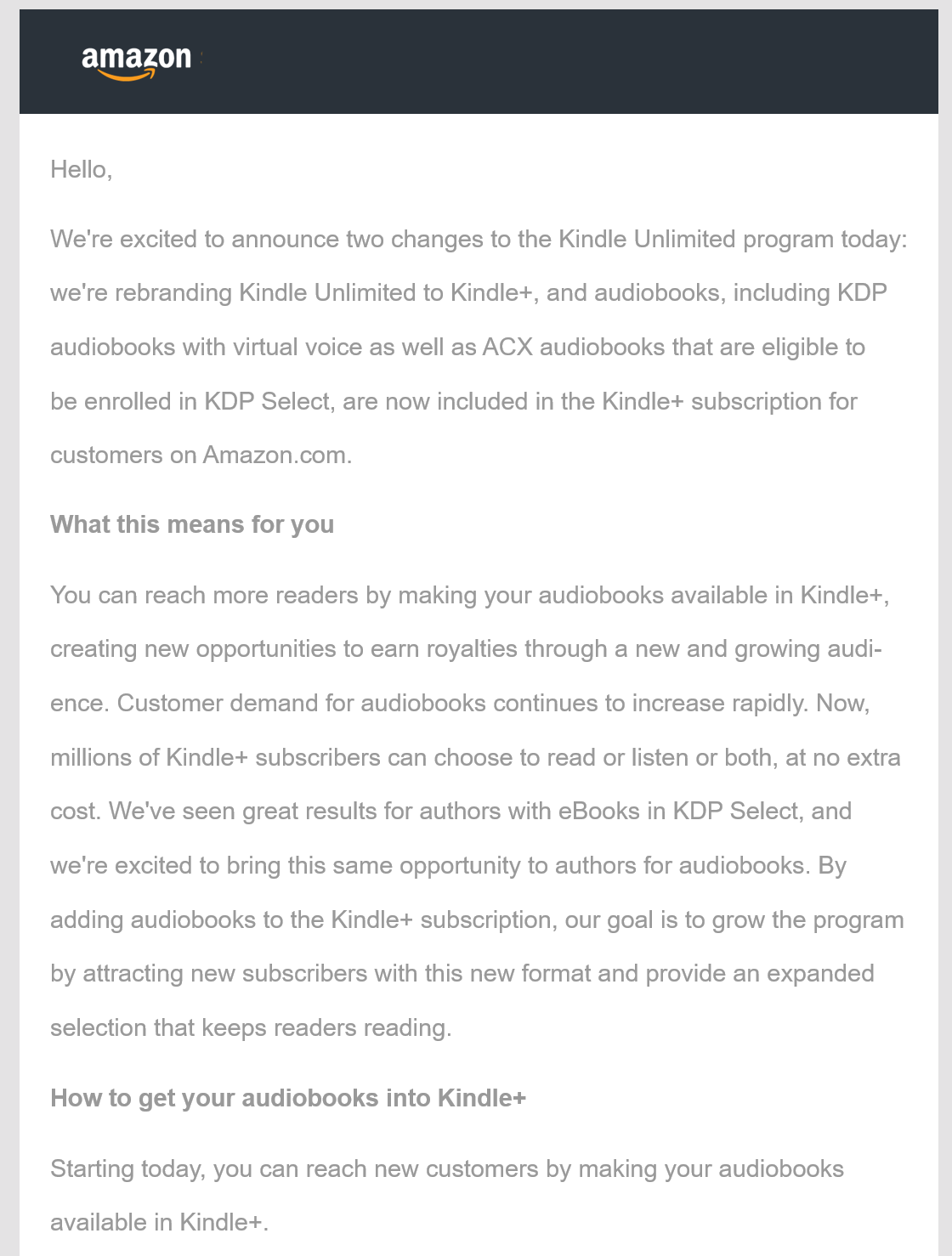
The important word is eligible. This does not mean every audiobook on Amazon or Audible is included.
The expansion covers qualifying KDP Virtual Voice audiobooks and eligible ACX audiobooks. Subscribers can access the included audio at no additional subscription cost.
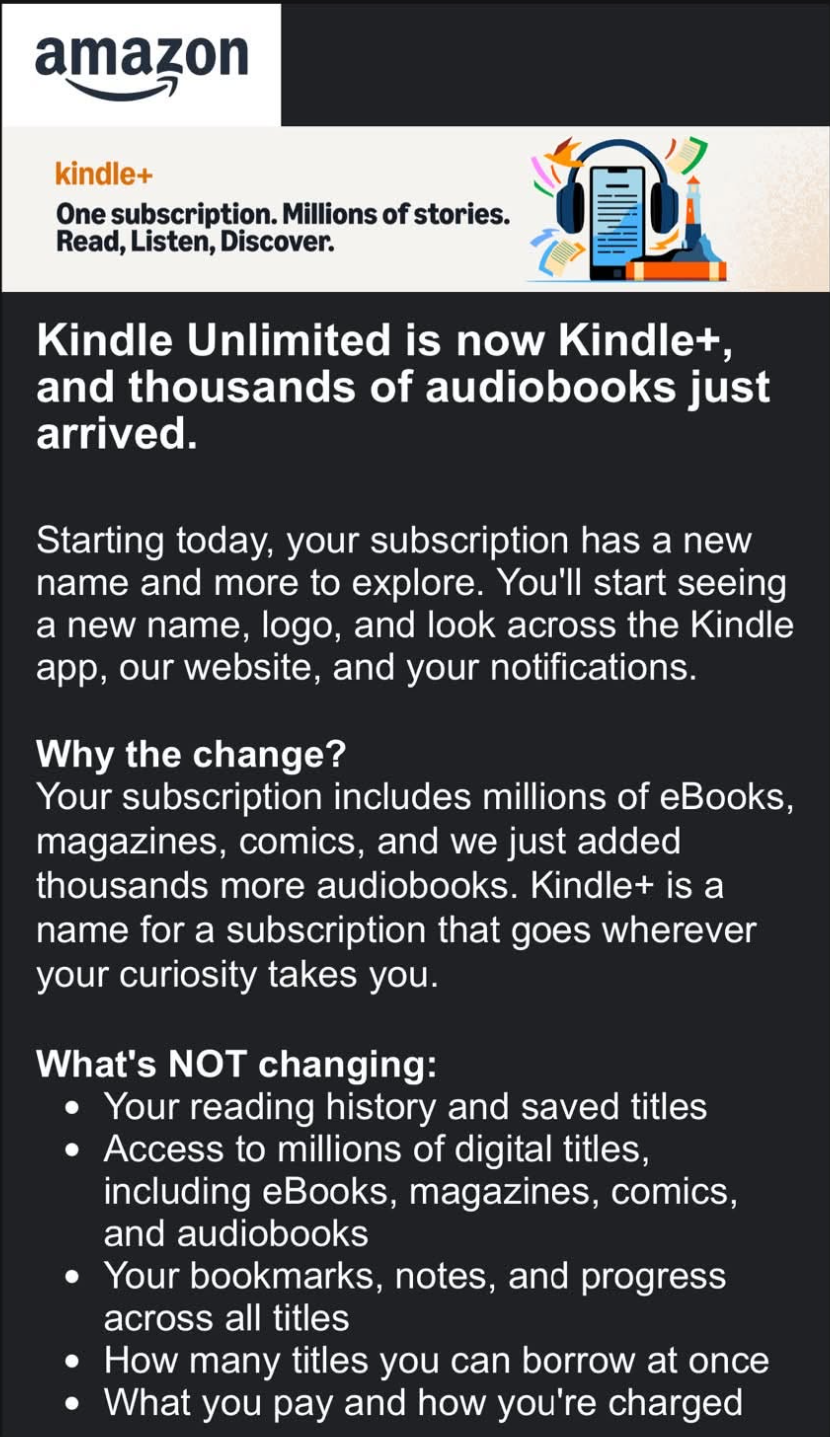
KDP’s Kindle+ overview confirms that audiobooks in Kindle+ are currently available to listeners in the United States, with more marketplaces planned. Authors outside the US can enroll eligible titles for distribution to US listeners.
What Is the Difference Between Kindle+ and KDP Select?
The names are easy to mix up:
- Kindle+ is the subscription readers purchase, formerly called Kindle Unlimited.
- KDP Select is the program authors enroll their eligible books in to participate.
KDP Select requires eBook exclusivity during its 90-day enrollment period, with an exception for public library distribution. You cannot sell or distribute the enrolled eBook through other retailers or your own website during that term. However, since September 2025, authors can distribute enrolled eBooks to public libraries through services such as OverDrive and Hoopla. Your print editions can still be sold elsewhere.
Now, audiobook exclusivity is a bigger part of the decision too. Virtual Voice participation brings restrictions on other audio editions, while eligible ACX audiobooks must already have exclusive Audible distribution.
Virtual Voice Audiobooks Are Included Automatically
Virtual Voice is Amazon’s computer-generated narration program through KDP.
If your eBook is enrolled in KDP Select and you have created a corresponding Virtual Voice audiobook, Amazon says that audiobook is now automatically included in Kindle+ as well as Audible Plus. If both are already in place, no additional enrollment action is required.
But here’s the part I don’t think Amazon made clear enough in its announcement: this affects your ability to distribute other audio editions of that book.
Amazon’s Virtual Voice terms state:
“During your Digital Book’s 90-day period of exclusivity, you also cannot sell or distribute, or give anyone else the right to sell or distribute, your Book in audio format.”
That restriction applies to any audio edition of the book, not just the Virtual Voice recording. You cannot get around it by creating a separate human-narrated edition or using another narration service for distribution elsewhere.
KDP’s audiobook guidance also says that unpublishing the Virtual Voice audiobook does not end the obligation early. Exclusivity continues through the remainder of the current 90-day participation period.
I was concerned to see that the announcement presents automatic enrollment without clearly explaining this restriction. Authors may understand eBook exclusivity without realizing that adding Virtual Voice also limits their audiobook options.
Before enrolling—or allowing an enrollment to renew—check how those terms affect the audio editions you already have or plan to create.
Note: According to KDP’s Virtual Voice eligibility guidance, if your corresponding eBook is not enrolled in KDP Select, you can distribute a separately produced audio edition elsewhere, provided you have no other exclusivity obligations. This does not allow you to distribute Amazon’s Virtual Voice recording through other platforms; Amazon retains ownership of that file. Enrolling the corresponding eBook in KDP Select triggers the audio exclusivity requirement. There may be an exception if the Virtual Voice audiobook is unpublished prior to enrollment and remains unpublished for the duration of the KDP Select agreement.
Which ACX Audiobooks Are Eligible for Kindle+?
Eligible ACX audiobooks can also join Kindle+, but enrollment is optional rather than automatic.
Amazon’s current ACX eligibility requirements include:
- Exclusive distribution through Audible.
- A Pay for Production arrangement.
- Read & Listen, formerly Whispersync for Voice, enabled.
- The associated eBook enrolled in KDP Select.
Royalty Share and Royalty Share Plus titles are not currently eligible. Amazon says it is exploring expanding eligibility to those payment models.
You can check eligibility and enroll qualifying titles through your KDP Bookshelf. KDP’s enrollment guidance clarifies that enrolling an ACX audiobook adds no additional KDP audiobook exclusivity requirements; your existing ACX distribution terms remain in place.
I would not give up wide audiobook distribution simply because this option is available. Look at what you currently earn, where your listeners find you, and what you stand to lose, including an established or growing audience outside Amazon.
Can Your eBook Be in Kindle+ Without Your Audiobook?
Yes. Your eBook can remain in KDP Select even if your audiobook is distributed nonexclusively. eBook enrollment alone does not make a separately produced audiobook exclusive. The Virtual Voice arrangement described above is an important exception.
Readers can still read your enrolled eBook through Kindle+ while purchasing the audiobook separately with money or an Audible credit, where available. If you distribute audio widely, listeners can also obtain it through your other retailers.
For those titles, the experience is essentially the same as before the Kindle+ rebrand: subscription access to the eBook, with the audiobook acquired separately.
What changes is the fund supporting your eBook earnings. Your eBook now shares the KDP Select Global Fund with eligible audiobook listening, even if your own audiobook does not participate in Kindle+.
How Do Kindle+ Royalties Work for Authors?
Amazon’s announcement explains:
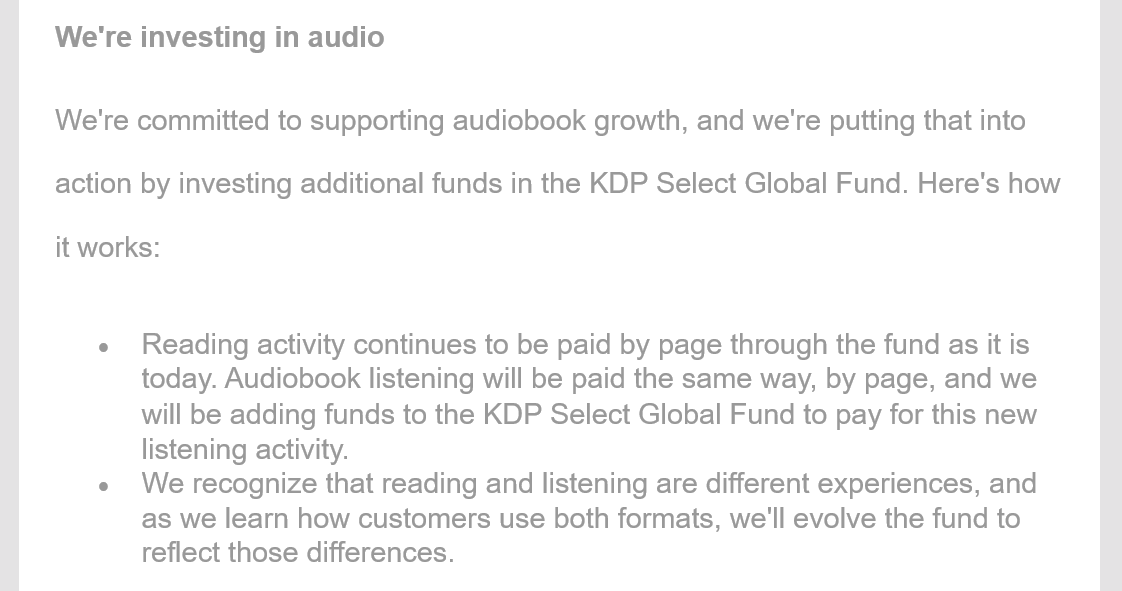
“Reading activity continues to be paid by page through the fund as it is today. Audiobook listening will be paid the same way, by page, and we will be adding funds to the KDP Select Global Fund to pay for this new listening activity.”
Kindle+ listening generates earnings through the KDP Select Global Fund, measured in pages listened to. It is not a fixed payment for each audiobook borrowed or a standard audiobook sales royalty.
I would expect many authors to earn less from a complete subscription listen than from a paid audiobook sale. The comparison will depend on the title, its sales royalty, and the subscription payout.
The hope is that more listeners make up the difference. That is familiar territory for Kindle Unlimited authors: earning less per completed read can still work if enough additional readers discover the book.
But that outcome is not guaranteed.
Where to Find Kindle+ Listening Activity and Royalties
You may need to review both KDP and ACX reports to understand your overall audiobook performance. Keep Kindle+ listening separate from other Audible activity when evaluating results.
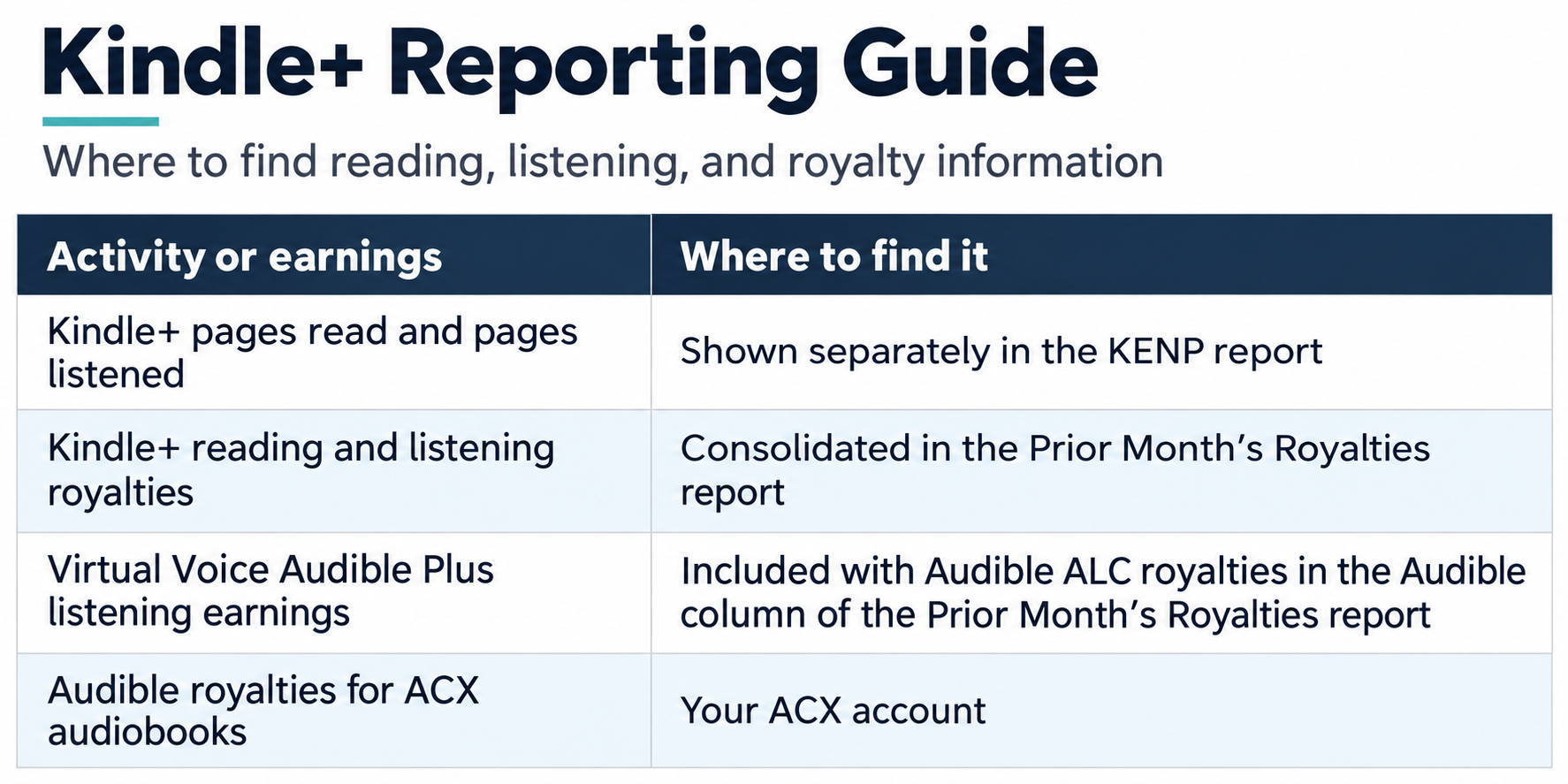
Source: KDP’s Kindle+ royalties and reporting guidance.
My Top Three Concerns: Royalties, AI and Exclusivity
-
Royalties: More Consumption, but Less Income?
-
Reading and Listening Now Share the Fund
Audiobook listening is joining the fund that previously paid for eBook reading. Meanwhile, Amazon says subscribers receive the additional audio access at no extra cost.
So we are adding more content and more ways to consume it without a corresponding subscription price increase announced alongside the change.
If subscription revenue does not increase alongside consumption, will spreading payments across eBooks and audiobooks reduce what authors earn overall?
Amazon says it is adding money to support listening, essentially subsidizing the expansion. That sounds promising, but the announcement does not specify how much additional funding it will provide or for how long.
Amazon also says:
“We recognize that reading and listening are different experiences, and as we learn how customers use both formats, we’ll evolve the fund to reflect those differences.”
My question is whether that funding will keep pace as the program grows.
I’m concerned that payouts could hold steady initially and gradually decrease later, after subscribers become accustomed to more access and authors become more dependent on an exclusive sales model. Small monthly changes may not attract much attention, but they can add up.
Amazon has not announced a rate decrease or said its additional funding is temporary. This is my concern about the long-term direction, not a confirmed change in compensation.
-
A Steady Page Rate Would Not Necessarily Mean Steady Income
There is another important detail: Kindle+ pays for the first consumption of each page, whether the subscriber reads it or listens to it.
If someone reads your eBook through Kindle+ and then listens to the same material through Kindle+, those pages do not earn a second payment. For simultaneous reading and listening, Amazon says the higher applicable rate is paid if the rates differ—not both rates.
Previously, a reader could read your eBook through Kindle Unlimited and then purchase the audiobook with money or an Audible credit, generating a separate audiobook royalty.
That can still happen if the customer purchases the audio. But when the audiobook is included in Kindle+, the subscriber can consume both formats without making that additional purchase.
My concern is that Kindle+ could replace some audiobook purchases and credit redemptions with subscription listening. That would mean losing a separate sales royalty, not simply changing how subscription activity is counted.
Even if Amazon grows the fund enough to maintain page rates as more audiobooks—including automatically enrolled Virtual Voice titles—enter the program, authors could still lose revenue if subscription listening replaces paid audiobook transactions.
Additional listeners could offset those losses, but they would need to generate enough new, paid consumption to make up the difference.
To me, that creates a real possibility of a net negative for authors: more content available to subscribers, fewer reasons to purchase audio separately, and stronger incentives for authors to remain exclusive to Amazon.
We need to watch total earnings across formats, not just whether the page rate holds steady.
-
-
AI: Will Readers Recognize Virtual Voice?
Audiobooks included in the subscription display a headphone badge alongside the Kindle+ badge.
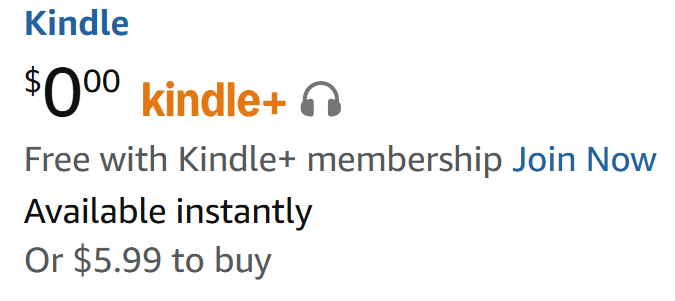
That tells readers listening is included. The symbol itself does not identify the narration as human or Virtual Voice.
In the desktop listings I reviewed, readers needed to click the audiobook format to see the Virtual Voice disclosure.

It wasn’t displayed on the eBook page where they could choose to read and listen through their subscription.
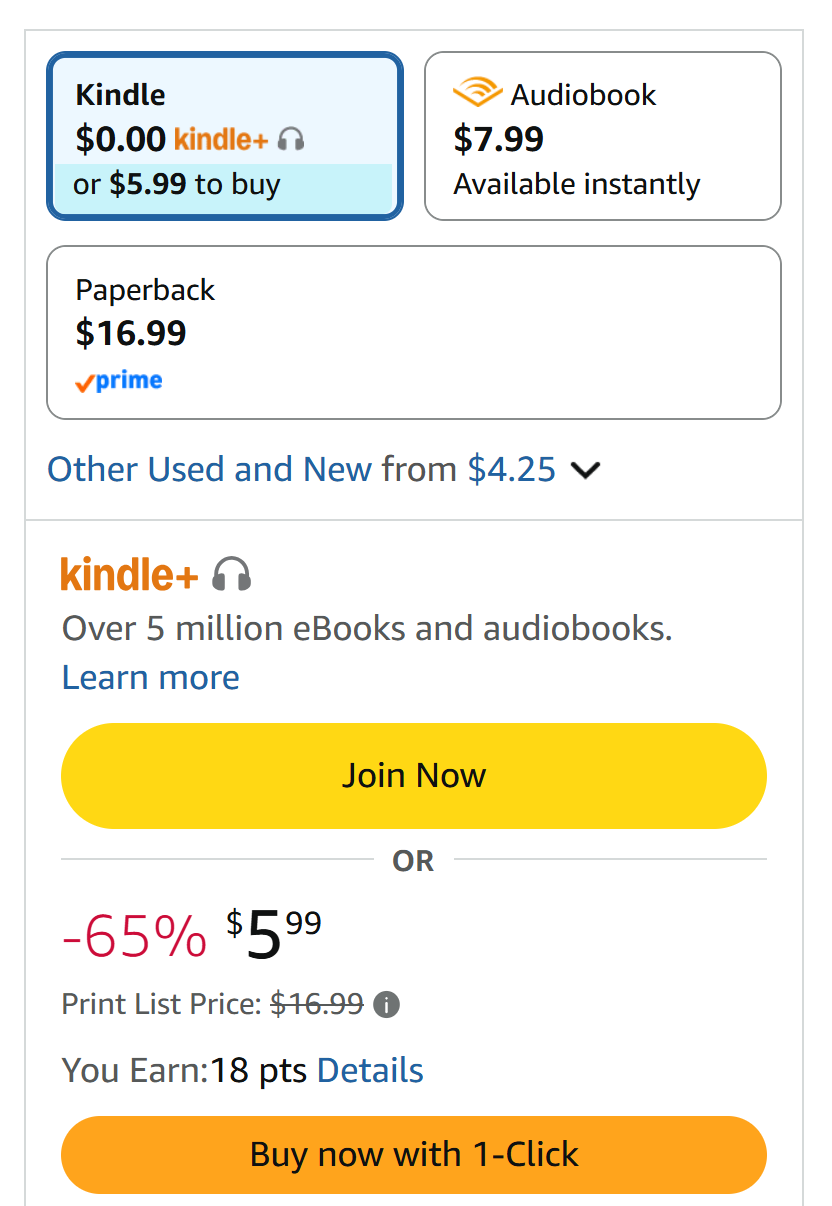
On Kindle and in the Kindle app, I saw Virtual Voice titles offering a ‘Virtual Voice Sample,’ while human-narrated audiobooks offered a ‘Preview Audio’ button. That distinction appeared only after opening the book listing.

This stood out to me because readers may choose a book based on its included audio without checking the narration first.
My suspicion is that this could introduce more readers to AI-narrated audiobooks before they realize that is what they selected. Which might kind of be the point.
-
Exclusivity: A Tighter Grip on the Audiobook Market?
Amazon describes the expansion as a way to attract subscribers, increase selection, and create new earning opportunities for authors.
My bet is that it also wants to bring more attention to Virtual Voice and encourage more authors to create those audiobooks.
For an author facing the cost of professional narration, reaching Kindle+ listeners through Virtual Voice may sound appealing. Pair that audiobook with an eBook in KDP Select, though, and audio exclusivity comes with it. ACX participation likewise requires an already exclusive audiobook.
With other audiobook platforms like Spotify competing for listeners, I have to wonder if this is Amazon’s effort to gain a tighter grip on the market.
Will this lure more readers and listeners into Amazon instead of other sales channels? (Keep in mind that Amazon announced this additional audio access at no extra subscription cost.) Will reader and listener behavior and exclusivity requirements make authors and publishers even more dependent on the sales behemoth?
We’ll have to wait and see. But I want us looking at what we earn and what we give up to participate.
Should Authors Enroll Their Audiobooks in Kindle+?
There is no single answer for every author.
If your eBook is already in KDP Select and your exclusively distributed ACX audiobook meets the requirements, Kindle+ may be worth testing.
If your audiobook is earning money across multiple retailers, you need a clear business reason to give up that distribution.
If you use Virtual Voice, make sure you understand how automatic inclusion affects all audio editions of your book.
As you evaluate the program, watch:
- Total earnings across eBook and audiobook formats.
- Changes in paid audiobook sales and credit-based royalties.
- Effective subscription payouts over several months.
- Revenue and audience reach you give up through exclusivity.
- Enrollment dates and renewal settings.
If you’re excited about the program, try it. But watch how it affects your income and what you’re getting paid for the work you created—especially over the long term.
I think the consumer will be well taken care of, especially at first. I want to make sure authors are too.








Thank you for the breakdown! This really helped me understand what’s going on. Amazon is always looking to tighten its grip on the book world, but authors are rarely helped in the process. 😐 As always, I’ll be staying Wide. 📚🗺️
Wide can be more work, but it’s very rewarding if you can figure it out!